
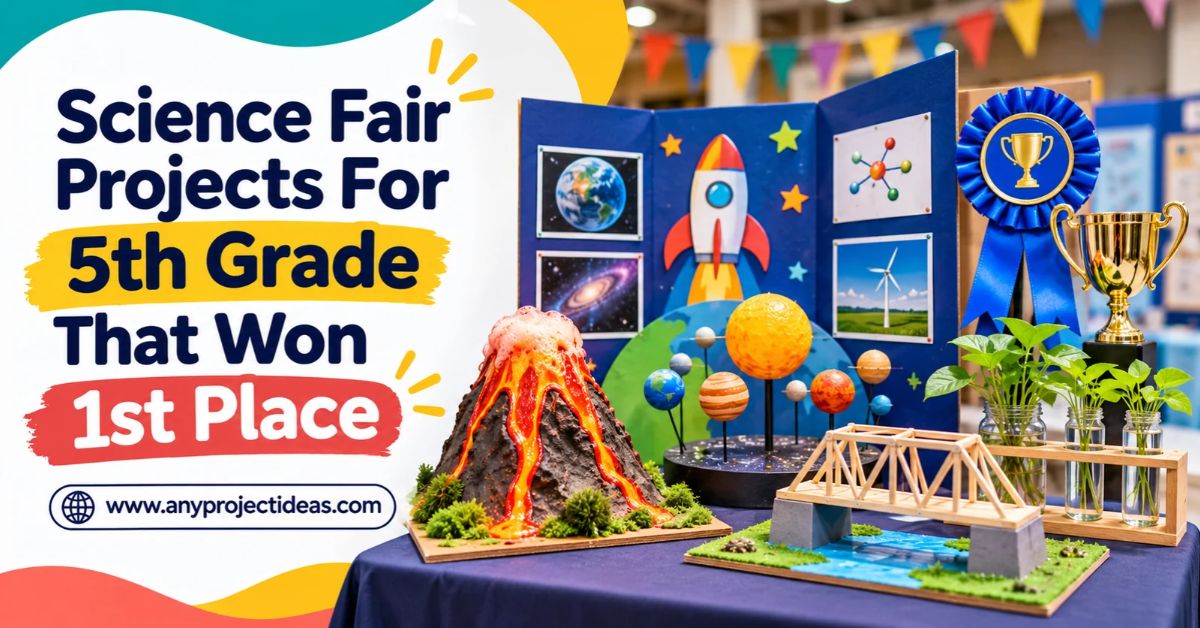
Science fairs become extra exciting when students can carry out their own investigations. Students can ask real questions such as: Why does ice melt faster on certain surfaces? Can plants grow without light? What material will keep the water warm for the longest time? These can then turn into fun and educational experiments.
As a 5th grader you don’t need to use any expensive equipment or complex scientific methods. All you need to do is ask a question, investigate a hypothesis, record your findings and explain what has happened.
To ensure your child gets first prize at their science fair, they should choose an interesting topic. However how they carry out the investigation and present it will also be important.
Some popular topics for elementary school science fairs are looking at plant growth, bubble creation, effects of different liquids on ice and how different materials work.
This blog contains some science fair projects for 5th graders. They are based around common winning themes. Each idea has a question to investigate and an easy way to collect data.
What Makes a Science Fair Project Good Enough to Win First Place?
A project can look impressive and still receive an average score if the student cannot explain how it works. Judges generally want to Shows interest and understanding.
- A clear aim
- A fair test. Only one variable should be changed and other factors should remain the same.
- Results should be recorded. Instead of just remembering results, they should be written down.
- Repeat results. This will show if results are consistent.
- A clear conclusion. The student should know why the results happened.
- A tidy layout. Photos, graphs, labels and a well presented board.
An experiment looking at melting ice can become more interesting by comparing different surfaces, measuring how long it takes to melt and explaining why results were different.
You May Also Like: Shark Tank Ideas for Students That Actually Work
20 The Best Science Fair Projects For 5th Grade That Won 1st Place
These projects cover different areas of science. Most use affordable materials that are easy to find at home or in a classroom.
1. Which Material Keeps Ice from Melting the Longest?
This experiment helps students understand insulation and heat transfer.
Materials: Ice cubes, aluminium foil, cotton cloth, newspaper, plastic wrap, and small containers.
How to conduct it:
- Place equal-sized ice cubes in separate containers.
- Wrap each container with a different material.
- Keep all containers in the same location.
- Record how long each ice cube takes to melt.
What to investigate: Which material slows down melting the most?
2. Does the Colour of a Surface Affect How Much Heat It Absorbs?
Dark and light surfaces can absorb different amounts of sunlight.
Materials: Black paper, white paper, two identical containers, thermometers, and sunlight.
How to conduct it:
- Cover one container with black paper and the other with white paper.
- Add equal amounts of water at the same starting temperature.
- Place both containers in sunlight.
- Record their temperatures at regular intervals.
What to investigate: Does the water in the black-covered container become warmer?
3. Which Liquid Makes Ice Melt the Fastest?
This is a simple experiment involving freezing and melting.
Materials: Ice cubes, water, salt, sugar, transparent bowls, and a timer.
How to conduct it:
- Place equal-sized ice cubes in separate bowls.
- Add equal amounts of different liquids or prepared solutions.
- Observe how quickly the ice changes.
- Record the melting time.
What to investigate: How do different substances affect the melting of ice?
4. Can Plants Grow Without Sunlight?
Plants need light for photosynthesis, but what happens when they receive very little light?
Materials: Three similar plants, pots, soil, water, and a measuring scale.
How to conduct it:
- Place one plant in sunlight.
- Keep another in partial shade.
- Place the third in a dark location for a short observation period.
- Give them equal amounts of water.
- Record changes in height, leaf colour, and appearance.
What to investigate: How does light availability affect plant growth?
5. Which Paper Towel Absorbs the Most Water?
This experiment compares the absorbency of everyday household products.
Materials: Different paper towel brands, water, measuring cups, and a tray.
How to conduct it:
- Cut equal-sized pieces of each paper towel.
- Pour the same amount of water onto each.
- Measure how much water each towel absorbs.
- Repeat the test.
What to investigate: Which paper towel absorbs the greatest amount of water?
6. Does Sugar Change How Fast Water Freezes?
Compare plain water with water containing different amounts of sugar. Keep the containers and starting conditions similar. Record the time required for each sample to freeze.
7. Which Soil Type Holds the Most Water?
Compare sand, garden soil, and clay-rich soil. Add equal amounts of water and measure how much drains through each sample. This project helps explain soil properties and water retention.
8. Which Shape Makes the Strongest Paper Bridge?
Build bridges using flat, folded, and triangular-folded paper. Place small weights on each bridge and record how much weight it supports before bending.
9. Does the Length of a Pendulum Affect Its Swing Time?
Make pendulums using string and small weights. Change the string length while keeping the weight similar. Count the swings and compare the results.
10. Which Liquid Conducts Electricity Better?
Use a safe, low-voltage educational circuit to compare the electrical conductivity of different liquids. Test plain water, salt water, and sugar water. Never use household mains electricity.
11. Can Salt Water Help an Egg Float?
Place an egg in plain water and then compare it with salt water. Gradually add salt and observe how the egg’s position changes.
This experiment demonstrates density and buoyancy.
12. Which Material Is the Best for Filtering Dirty Water?
Compare layers of sand, gravel, and filter paper using prepared muddy water. Observe how the appearance of the water changes after filtration. Do not drink the filtered water.
13. Does Water Temperature Affect How Quickly Sugar Dissolves?
Add equal amounts of sugar to cold, room-temperature, and warm water. Stir each sample in the same way and record how long the sugar takes to dissolve.
14. Which Paper Airplane Design Flies the Farthest?
Make different paper airplane designs using the same paper size. Throw each plane from the same starting point and measure the distance travelled.
15. Does the Amount of Sunlight Affect Solar Panel Output?
Use a small educational solar panel and a suitable meter. Compare its output in direct sunlight, partial shade, and indirect light.
16. Which Fruit Produces the Most Juice?
Compare oranges, lemons, and other fruits. Use equal quantities of fruit and the same squeezing method. Measure the amount of juice collected.
17. How Does Salt Affect Plant Growth?
Grow similar plants under different salt concentrations. Keep sunlight, soil, and water volume consistent. Observe plant height and leaf condition over time.
18. Which Material Is the Best Sound Insulator?
Place a sound source inside a box and cover it with different materials. Use a sound meter application to compare sound levels at a fixed distance.
19. How Does Surface Texture Affect Friction?
Slide the same object over smooth paper, rough fabric, cardboard, and other surfaces. Compare the force needed to move it using a spring scale.
20. Can a Homemade Water Wheel Generate Electricity?
Build a small water wheel using lightweight materials. Connect it to a suitable small motor and LED. Investigate how water flow affects its movement and electrical output.
More Interesting Science Fair Project Ideas for 5th Graders
If you want to explore something different, here are additional topics that can be developed into proper experiments.
Biology and Plant Science
- Does the size of a seed affect germination time?
- Which type of soil helps bean plants grow taller?
- Do plants grow better with natural or artificial light?
- How does water temperature affect seed germination?
- Does the number of leaves affect plant growth?
- Which fruits turn brown the fastest after cutting?
- Does sunlight affect the colour of leaves?
- How does the amount of water affect plant height?
- Do different seeds germinate at different speeds?
- Can plants grow using recycled water?
Chemistry and Everyday Materials
- Which household liquid is the most acidic?
- Does temperature change how quickly baking soda reacts with vinegar?
- Which material rusts the fastest under similar conditions?
- Can lemon juice help prevent apple slices from turning brown?
- Does the amount of salt affect the density of water?
- Which type of soap produces the most bubbles?
- How does water temperature affect bubble formation?
- Which natural material can remove stains most effectively?
- Does the amount of baking soda change the size of a chemical reaction?
- Which paper material breaks down fastest in water?
Physics and Engineering
- Which ramp angle allows a toy car to travel farthest?
- Does the weight of a paper airplane affect its flight?
- Which magnet can lift the most paper clips?
- How does the length of a rubber band affect its stretch?
- Which balloon size produces the longest rocket flight?
- Can different shapes improve the strength of a paper tower?
- How does wheel size affect the distance travelled by a toy car?
- Which material provides the best insulation?
- How does the height of a ramp affect a rolling ball?
- Can a simple pulley make lifting objects easier?
How to Turn a Simple Experiment into a First-Place Project?
You will also need to describe what you did and what you learned.
Ways to make your experiment engaging:
Ask a measurable question.
Instead of asking if plants grow better with more sunshine, ask how much more the plants’ height increases when given different amounts of sunshine over a 2 week period.
Make it a fair test.
Only change one variable. In a plant experiment, keep the pots, soil, seeds and amount of watering the same.
Repeat.
This way you can see if there really is a pattern. Investigate using multiple samples or repeat your experiment.
Keep a record.
Keep a little science journal with your dates, measurements, pictures, unexpected results and any changes made.
Describe the science.
Don’t just state that one material worked better. Describe why the material could have worked better based on a property.
How to Prepare a Science Fair Display Board?
A well laid out display board will help the judges to understand your experiment.
Set up the board like this:
- Title: Create a short title that tells us what your experiment was about.
- Question: What did you want to know?
- Hypothesis: What did you think would happen?
- Materials: List all the materials you used.
- Method: Describe how you carried out your experiment.
- Results: Record your results including any measurements, tables and graphs.
- Conclusion: Tell us what you found out.
- Improvements: Tell us what you would do differently next time.
Include real photos of your experiment. Often it is much more useful to have a simple graph to show your results rather than a few paragraphs.
Questions Judges May Ask During a Science Fair
Fifth graders should be prepared to explain their work without memorising a long speech.
Some common questions include:
- Why did you select this topic?
- What were you trying to find out?
- What did you predict before starting?
- Which materials did you use?
- What did you change during the experiment?
- What did you keep the same?
- Were your results what you expected?
- What was the most surprising observation?
- What would you change if you repeated the experiment?
A student should understand the experiment well enough to explain it in their own words. This is particularly important because some elementary science fairs place considerable weight on the student interview.
Don’t Skip: What Should You Do If AI Gives You An Answer That Seems Incorrect Or Biased?
Conclusion
Whilst it doesn’t have to be the biggest or most expensive project you can create an impressive project by planning your experiment well with a clear question, accurate observations and some thoughtful analysis.
The best science fair projects for 5th grade will encourage children to ask questions and find out the answers.
Choose a topic your child will be genuinely interested in. They can carry out some experiments and record their findings. Think about how they can improve their project. Even if they don’t get the results they were expecting there will still be something they can learn from it.
Most importantly allow the student to take ownership of their project. Whilst the aim may be to win a 1st place ribbon the aim is to help them become curious, confident and gain a greater understanding of how science works.
Frequently Asked Questions (FAQs)
1. What is the best science fair project for 5th grade?
Ice melting, plant growth, water filtration, and paper bridge strength are excellent topics for fifth graders.
2. How can a 5th grader win first place in a science fair?
Choose a testable question, conduct a fair experiment, record results, and explain the findings clearly.
3. What materials are needed for a 5th grade science fair project?
Most projects use simple materials such as paper, water, plants, containers, thermometers, and measuring tools.
4. How long should a 5th grade science fair project take?
Simple experiments may take a day, while plant growth and similar projects can require several weeks.
5. Should a 5th grade science fair project include a hypothesis?
Yes. A hypothesis explains what the student expects to happen and why.