
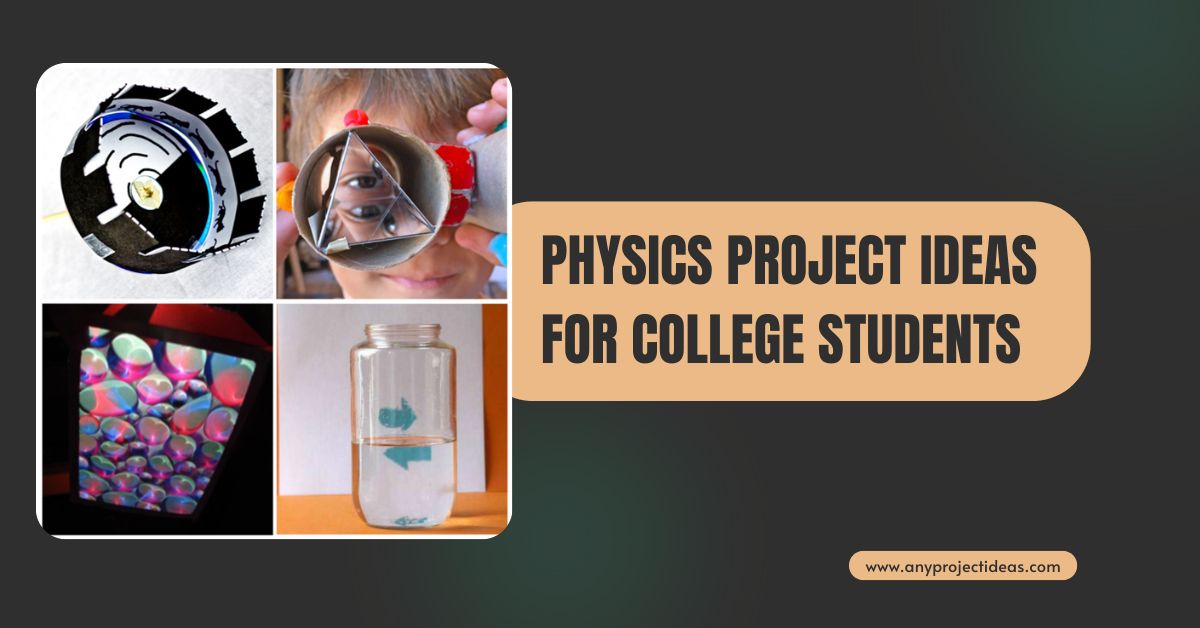
Physics is not just a subject—it’s the foundation of how the universe works. From understanding motion to exploring quantum mechanics, physics helps students develop analytical thinking and problem-solving skills that go far beyond the classroom.
But let’s be honest—choosing the right project can feel harder than solving a tricky equation.
If you’re stuck, this guide provides 250+ physics project ideas for college students, carefully categorized to match different interests and academic levels. Along with the ideas, you’ll also learn how to choose the right project and make it stand out.
Why Physics Projects Matter in College?
Physics projects bridge the gap between theory and real-world application. Instead of just memorizing formulas, you get to test, observe, and validate concepts.
Research in STEM education shows that students who engage in project-based learning demonstrate:
- Better conceptual understanding
- Improved analytical skills
- Higher retention of knowledge
In short, projects help you think like a physicist, not just study like one.
You May Also Like: Ceramics Project Ideas
250+ Physics Project Ideas for College Students
Here is a comprehensive list of 250+ physics project ideas for college students, organized into key domains.
Mechanics and Motion Projects
- Study of projectile motion
- Simple pendulum experiment
- Friction analysis on surfaces
- Newton’s laws demonstration
- Rotational motion analysis
- Energy conservation experiment
- Momentum conservation study
- Center of mass experiment
- Inclined plane motion
- Oscillation experiments
- Damped harmonic motion
- Free fall analysis
- Rolling motion of objects
- Gyroscope behavior study
- Elastic vs inelastic collisions
- Torque measurement
- Circular motion experiment
- Stability of structures
- Velocity-time graph analysis
- Acceleration measurement
- Motion under gravity
- Spring constant measurement
- Hooke’s law experiment
- Fluid motion basics
- Air resistance study
- Motion tracking using sensors
- Mechanical advantage systems
- Balance and equilibrium study
- Rotational inertia experiment
- Vibrational motion analysis
Electricity and Electronics Projects
- Ohm’s law verification
- Series and parallel circuits
- Battery efficiency testing
- Capacitor charging and discharging
- Transformer model
- Electrical energy consumption study
- Simple motor construction
- Generator working model
- Magnetic field mapping
- Induction experiment
- Resistance variation study
- Semiconductor basics
- Diode characteristics
- Transistor amplifier circuit
- Logic gates using circuits
- Power supply design
- LED brightness control
- Solar cell efficiency
- Wireless power transfer
- Circuit simulation project
- Electrical safety model
- Current measurement system
- Voltage regulation
- Smart lighting system
- Arduino-based circuits
- IoT-based monitoring system
- Digital electronics basics
- Signal processing model
- Sensor-based automation
- Smart switch system
Optics and Light Projects
- Reflection and refraction study
- Lens focal length measurement
- Prism light dispersion
- Optical fiber communication
- Diffraction experiment
- Interference patterns
- Polarization of light
- Laser experiments
- Optical illusions study
- Telescope model
- Microscope construction
- Light intensity measurement
- Color spectrum analysis
- Total internal reflection
- Holography basics
- Photoelectric effect experiment
- Light absorption study
- Optical sensors
- Imaging systems
- Fiber optic transmission
Thermodynamics Projects
- Heat transfer experiment
- Specific heat capacity
- Thermal conductivity
- Expansion of solids
- Gas laws verification
- Carnot engine model
- Refrigerator working model
- Heat engine efficiency
- Temperature measurement
- Phase change study
- Entropy basics
- Thermal equilibrium
- Radiation heat transfer
- Insulation materials study
- Solar cooker model
- Climate temperature analysis
- Thermocouple experiment
- Energy conversion systems
- Heat loss prevention
- Renewable energy systems
Modern Physics Projects
- Photoelectric effect
- Atomic models study
- Nuclear radiation detection
- Quantum mechanics basics
- Particle physics overview
- Relativity concepts
- Wave-particle duality
- Laser physics
- Semiconductor physics
- X-ray applications
- Radioactivity measurement
- Nuclear energy model
- Quantum computing basics
- Spectroscopy study
- Atomic spectra analysis
- Nanotechnology basics
- Particle detectors
- Cosmic rays study
- Fusion vs fission
- Modern imaging systems
Environmental and Applied Physics Projects
- Solar panel efficiency
- Wind energy model
- Hydropower generation
- Noise pollution measurement
- Air quality monitoring
- Water purification systems
- Climate change modeling
- Energy conservation methods
- Smart grid system
- Sustainable building design
- Green energy solutions
- Electric vehicle model
- Battery storage systems
- Renewable energy integration
- Environmental sensors
- Waste energy utilization
- Solar tracking system
- Eco-friendly lighting
- Sustainable materials study
- Urban heat island effect
Advanced and Innovative Physics Projects
- AI in physics simulations
- Robotics integration
- Autonomous systems
- Smart home automation
- Machine learning models
- Quantum encryption
- Space propulsion systems
- Satellite communication
- Drone physics
- Augmented reality in physics
- Virtual labs
- Advanced robotics
- Neural networks in physics
- Data analysis in experiments
- Space exploration models
- Astrophysics simulations
- Black hole models
- Gravitational waves study
- Dark matter research
- Time dilation experiments
Bonus Ideas to Cross 250+
- Plasma physics experiments
- Magnetic levitation model
- Superconductivity basics
- Acoustic wave studies
- Seismology experiments
- Fluid turbulence analysis
- Chaos theory demonstration
- Biophysics applications
- Medical imaging physics
- Brain signal analysis
- Optical computing
- Smart materials study
- Nanoelectronics
- Radiation shielding
- Energy harvesting systems
- Wireless sensor networks
- Photonics applications
- Advanced spectroscopy
- Laser communication
- Smart wearable devices
- Cryogenics basics
- Spintronics research
- Plasma confinement
- Fusion reactor models
- Quantum optics
- Optical trapping
- High-energy particle simulation
- Astrobiology physics
- Interstellar travel concepts
- Satellite orbit simulation
- Solar flare analysis
- Earthquake wave models
- Bioelectric signals
- Renewable hybrid systems
- Smart transportation systems
- Autonomous vehicle sensors
- Energy-efficient circuits
- Advanced sensor design
- Digital twin simulations
- Smart city physics models
- Microfluidics study
- Optical sensors design
- Energy optimization algorithms
- Computational physics models
- Physics-based game engines
- Real-time data acquisition systems
- Laser cooling basics
- Photovoltaic material study
- Acoustic levitation
- Quantum tunneling experiments
- Thermal imaging systems
- Advanced wave simulations
- Nonlinear dynamics study
- Space weather analysis
- Plasma propulsion
- High-speed aerodynamics
- Turbine efficiency study
- Microgravity experiments
- Optical encryption
- Quantum sensors
- Energy storage innovations
- Smart grid simulations
- Magnetic resonance basics
- Advanced fluid mechanics
- Computational thermodynamics
- Particle accelerator models
- Optical coherence tomography
- Electromagnetic shielding
- Advanced robotics sensors
- Climate physics modeling
- Laser spectroscopy
- Smart energy meters
- Optical communication systems
- Renewable microgrids
- Energy harvesting wearables
- Advanced battery chemistry
- Fluid-structure interaction
- Atmospheric physics studies
- Ocean wave energy
- Heat exchanger design
- Smart irrigation systems
- Electromagnetic wave propagation
- Optical data storage
- High-frequency circuits
- Space debris tracking
- Quantum simulations
- Thermal management systems
- Sensor fusion systems
- Smart manufacturing physics
- Energy-efficient building systems
- Quantum dot applications in modern electronics
- Simulation of gravitational lensing effects
How to Choose the Right Physics Project?
With so many options, selection becomes critical.
Focus on:
- Your area of interest
- Available resources and equipment
- Time constraints
- Academic requirements
A well-executed simple project is always better than an incomplete complex one.
Tips to Make Your Physics Project Stand Out
To create a strong impression:
- Define a clear objective
- Use accurate measurements and data
- Present results with graphs and analysis
- Connect theory with real-world applications
- Document your methodology clearly
Precision and clarity matter more than complexity.
Common Mistakes to Avoid
Avoid these common pitfalls:
- Choosing overly broad topics
- Lack of experimental validation
- Poor data analysis
- Weak presentation
- Ignoring practical applications
Fixing these can significantly improve your project quality.
Don’t Miss: Alamo Project Ideas for Students
Final Thoughts
These physics project ideas for college students offer a wide range of opportunities to explore concepts, build practical skills, and develop a deeper understanding of physics.
Choose a topic that excites you, stay consistent, and focus on learning through experimentation. Physics becomes far more interesting when you see it in action.