
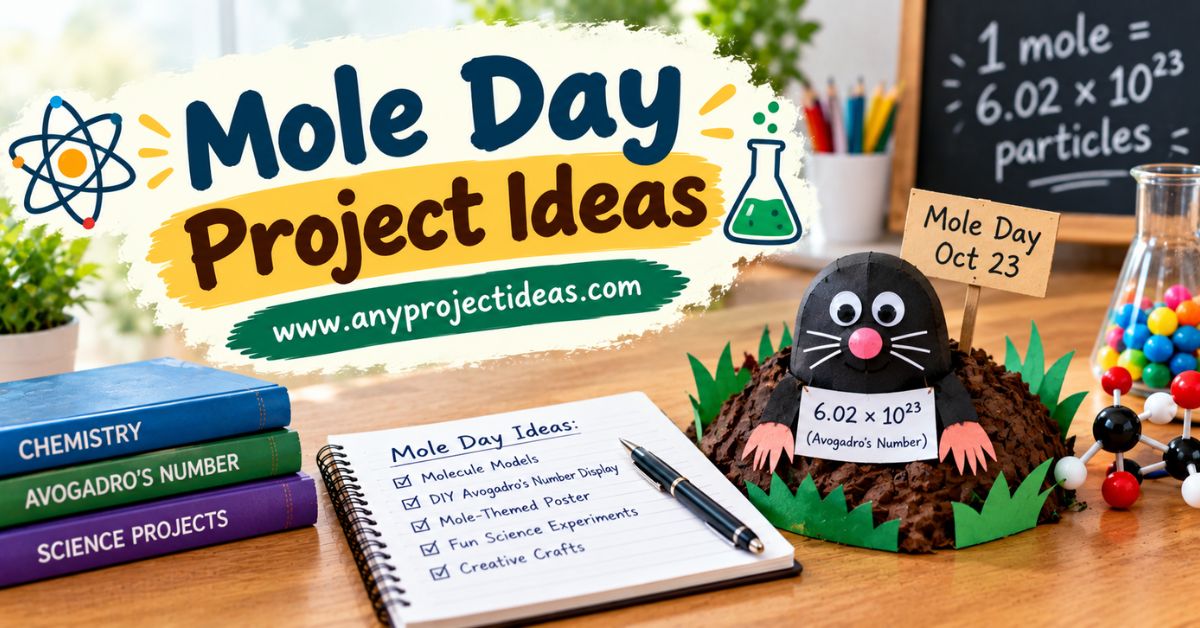
Mole Day is a fun way for chemistry students to turn an important scientific concept into a creative classroom experience. Instead of studying the mole only through formulas and calculations, students can use models, experiments, posters, games, crafts, and demonstrations to understand why the mole is so important in chemistry.
If you are searching for mole day project ideas, you can choose from many different types of activities depending on your grade level, available materials, and assignment requirements. Some projects focus on Avogadro’s number, while others demonstrate molar mass, particle counting, chemical reactions, measurement, or the history of the mole.
The best Mole Day projects combine chemistry with creativity. You do not need an expensive laboratory setup to create an impressive project. Simple household materials, classroom supplies, recycled objects, and basic measuring tools can be enough to demonstrate a surprisingly complex chemistry concept.
What Is Mole Day?
Mole Day is an unofficial chemistry celebration observed on October 23, commonly from 6:02 a.m. to 6:02 p.m. The date and time represent 6.02 × 10²³, which is approximately Avogadro’s number.
In chemistry, a mole is a counting unit used to describe an enormous number of particles. Just as a dozen means 12 objects, one mole represents approximately 6.022 × 10²³ particles. These particles can include atoms, molecules, ions, or other specified entities.
Mole Day gives students an opportunity to explore this idea in a memorable way. A project might use a visual model to represent Avogadro’s number, compare quantities of everyday materials, or demonstrate how chemists connect microscopic particles with measurable amounts of matter.
You May Also Like: What Is the Purpose of the Community Safety Education Act?
50+ Mole Day Project Ideas
Avogadro’s Number Project Ideas
Understanding Avogadro’s number is one of the most important parts of learning about the mole. These projects make the enormous number easier to visualize.
1. Avogadro’s Number Poster
Create a colorful poster explaining 6.022 × 10²³ with examples showing how many atoms, molecules, or ions are contained in one mole.
2. Visualizing Avogadro’s Number
Use dots, beads, grains, or small paper circles to create a scale model that helps explain why Avogadro’s number is so large.
3. Avogadro’s Number Infographic
Design an infographic connecting the mole, Avogadro’s number, atoms, molecules, and molar mass using simple diagrams.
4. One Mole of Objects Display
Choose a familiar object such as paper clips and calculate how much space or mass one mole would theoretically represent.
5. Avogadro’s Number Comparison
Compare Avogadro’s number with smaller quantities such as a dozen, thousand, million, and billion to show the enormous scale of a mole.
6. Mole Counting Challenge
Create a classroom activity where students convert between particles and moles using Avogadro’s number.
7. Avogadro’s Number Comic
Make a short chemistry comic in which a character explains why scientists use the mole to count microscopic particles.
8. Avogadro’s Number Model
Build a three-dimensional model using beads, balls, blocks, or other objects to represent the relationship between particles and moles.
9. How Big Is a Mole?
Create a visual presentation explaining why counting individual atoms is impractical and how the mole solves this problem.
10. Avogadro Biography Project
Research Amedeo Avogadro and create a biography explaining his scientific contributions and the later development of the concept associated with his name.
Molar Mass Project Ideas
Molar mass connects the microscopic world of atoms with measurements made in grams. These projects can help students understand why the periodic table is essential for mole calculations.
11. Molar Mass Poster
Create a poster showing how atomic masses from the periodic table are added to calculate the molar mass of a compound.
12. Molar Mass Calculator Display
Design a classroom display showing step-by-step calculations for common compounds such as water, carbon dioxide, and sodium chloride.
13. Compound Mass Comparison
Compare the molar masses of several familiar compounds and explain why their values differ.
14. Molar Mass Flashcards
Create flashcards featuring common chemical compounds on one side and their molar masses on the other.
15. Molar Mass Matching Game
Make a matching game where students connect chemical formulas with their correct molar masses.
16. Periodic Table Molar Mass Project
Create an enlarged periodic table highlighting how atomic masses are used in mole calculations.
17. Molar Mass Mystery Challenge
Give classmates unknown chemical formulas and let them calculate the molar masses as part of a classroom competition.
18. Comparing Elements by Mole
Choose several elements and compare their atomic masses to explain why equal numbers of different atoms can have different masses.
19. Molar Mass Recipe Card
Create recipe-style cards showing how many grams of each element contribute to one mole of a selected compound.
20. Molar Mass Calculator Wheel
Design a rotating paper wheel that helps students practice calculating the molar mass of different compounds.
Creative Mole Day Crafts
If your teacher allows creative projects, chemistry-themed crafts can make your Mole Day celebration more colorful while still teaching important concepts.
21. Mole Character Craft
Create a friendly mole character and decorate it with chemistry symbols, formulas, safety goggles, or a lab coat.
22. Mole Day Crown
Design a paper crown featuring Avogadro’s number, the mole symbol, chemical formulas, and fun chemistry illustrations.
23. Mole Day Mask
Create a mole-themed mask using paper, cardboard, markers, and other classroom-safe craft materials.
24. Mole-Themed Bookmark
Design bookmarks featuring chemistry facts, mole equations, periodic table symbols, or Avogadro’s number.
25. Mole Day Greeting Card
Create a humorous chemistry greeting card celebrating Mole Day with a science-related message or pun.
26. Paper Mole Family
Make several paper moles representing atoms, molecules, ions, and compounds, then arrange them into a classroom display.
27. Mole Day Badge
Create wearable badges featuring a mole illustration and an interesting chemistry fact.
28. Mole Lab Coat Design
Design a paper lab coat featuring chemical formulas, laboratory symbols, and Mole Day decorations.
29. Chemistry Mole Mobile
Create a hanging mobile using paper molecules, atoms, periodic table symbols, and mole characters.
30. Mole Day Classroom Banner
Design a large banner explaining Mole Day and displaying 6.022 × 10²³ in an eye-catching way.
Mole Day Experiment Ideas
Simple experiments can help students connect mole calculations with measurable quantities. Always follow your teacher’s laboratory safety instructions and use appropriate supervision.
31. Measuring One Mole of Water
Calculate the mass of one mole of water and explain how its theoretical value connects with laboratory measurement.
32. Baking Soda Mole Calculation
Use the chemical formula of baking soda to calculate its molar mass and determine how many moles are present in a measured sample.
33. Salt Mole Investigation
Measure a safe quantity of table salt and calculate the approximate number of moles it contains.
34. Sugar Mole Experiment
Use sugar’s chemical formula and a measured sample to calculate its molar mass and number of moles.
35. Carbon Dioxide Mole Demonstration
Use a safe classroom reaction to discuss how a measured amount of carbon dioxide relates to moles.
36. Mole-to-Gram Conversion Lab
Choose a safe classroom substance and practice converting a measured mass into moles.
37. Gram-to-Particle Calculation
Use a known sample to calculate the theoretical number of particles represented by its measured mass.
38. Mole Ratio Demonstration
Use a simple chemical equation to show how mole ratios describe relationships between reactants and products.
39. Limiting Reactant Activity
Create a model using different colored objects to demonstrate how one reactant can limit the amount of product formed.
40. Chemical Equation Mole Model
Use blocks, beads, or paper objects to represent molecules and demonstrate how balanced equations describe mole relationships.
Mole Day Games and Interactive Projects
Interactive activities can make Mole Day especially engaging because students learn while participating.
41. Mole Day Trivia Game
Create a trivia game with questions about moles, Avogadro’s number, molar mass, chemical formulas, and famous chemists.
42. Mole Bingo
Create bingo cards containing chemistry terms, formulas, and mole-related calculations.
43. Mole Equation Relay
Organize a classroom relay where teams solve mole conversion problems before passing the turn to the next participant.
44. Mole Matching Game
Create cards featuring chemical formulas, molar masses, particle counts, and mole values that students must correctly match.
45. Chemistry Scavenger Hunt
Hide chemistry questions around the classroom and ask students to solve each problem to find the next clue.
46. Mole Jeopardy
Create a Jeopardy-style game with categories such as Avogadro’s number, molar mass, conversions, formulas, and chemistry history.
47. Mole Escape Room
Design chemistry puzzles involving mole calculations that students must solve to complete a classroom escape-room challenge.
48. Mole Quiz Wheel
Create a spinning wheel with different categories of mole questions and allow students to answer based on where the wheel lands.
49. Mole Calculation Challenge
Prepare increasingly difficult mole problems and let students work individually or in teams to solve them.
50. Guess the Mole Activity
Show students a measured quantity of a substance and ask them to estimate how many moles it contains before calculating the actual answer.
Mole Day Research and Presentation Projects
Students who prefer writing, research, or presentations can explore the scientific history and applications of the mole.
51. History of the Mole
Research how the concept of the mole developed and explain why chemists needed a practical way to count microscopic particles.
52. Importance of the Mole in Chemistry
Create a presentation explaining how the mole helps scientists connect atoms and molecules with measurable quantities.
53. Mole in Everyday Life
Explore examples of mole calculations in cooking, medicine, manufacturing, environmental science, and other fields.
54. Mole Concept in Medicine
Research how chemical quantities and molar concentrations are relevant to pharmaceuticals, laboratory testing, or medical research.
55. Mole Concept in Environmental Science
Explain how mole calculations can help scientists measure and analyze gases, pollutants, chemical concentrations, and environmental reactions.
How to Choose the Best Mole Day Project?
With so many Mole Day project ideas, the best choice depends on your grade level, chemistry knowledge, available materials, and assignment requirements.
If you enjoy art, choose a mole character, infographic, classroom banner, or three-dimensional model. If you prefer mathematics, a molar mass calculator project or mole conversion challenge may be better. Students interested in laboratory work can choose a safe measurement-based activity with teacher supervision.
Before starting, ask yourself three questions:
- What chemistry concept will my project explain?
- Can I complete it with the materials and time available?
- Will someone looking at my project learn something about the mole?
If the answer to all three is yes, you probably have a strong project idea.
How to Make Your Mole Day Project Stand Out?
A good project should be more than a collection of chemistry facts. Start with one clear concept and explain it in a way that another student can understand.
For example, instead of simply writing “One mole equals 6.022 × 10²³ particles,” create a visual explanation showing why such a large counting unit is useful. You can also include a practical example involving grams, particles, or a familiar substance.
Keep your design organized. Use clear headings, readable labels, accurate calculations, and appropriate illustrations. If you use information from books or websites, record your sources so your project demonstrates responsible research.
Common Mistakes to Avoid in a Mole Day Project
Students sometimes make Mole Day projects unnecessarily complicated. Avoid filling your poster with formulas that you cannot explain. Your project should demonstrate understanding rather than simply displaying difficult-looking equations.
Also check every calculation carefully. A small mistake in a chemical formula or atomic mass can affect the final molar-mass calculation.
Other common mistakes include:
- Confusing a mole with a molecule
- Writing Avogadro’s number incorrectly
- Forgetting units in calculations
- Using incorrect chemical formulas
- Adding too much text to a poster
- Using unreliable sources
- Choosing an experiment without proper safety guidance
- Focusing on decoration instead of chemistry
Why Mole Day Projects Are Useful?
Mole Day projects give students a chance to approach chemistry from different directions. Some students understand scientific concepts better through calculations, while others learn more effectively through models, demonstrations, art, or games.
A project can also make an abstract idea feel more concrete. Atoms and molecules are far too small to count individually, and Avogadro’s number is far too large to visualize easily. A creative project gives students a way to communicate these difficult ideas using familiar objects and situations.
Most importantly, Mole Day encourages students to see chemistry as more than a collection of formulas. The mole is a practical tool that allows scientists to connect the microscopic world of particles with measurable quantities in the laboratory.
Don’t Skip: What Should You Do If AI Gives You An Answer That Seems Incorrect Or Biased?
Conclusion
Mole Day is a great opportunity to make chemistry more creative, practical, and memorable. Whether you choose a colorful poster, an Avogadro’s number model, a molar mass activity, a chemistry game, a research presentation, or a safe classroom experiment, your project can help explain one of chemistry’s most important concepts.
The 50+ Mole Day project ideas in this guide offer options for different interests and learning styles. You can choose a project based on calculations if you enjoy mathematics, a craft if you prefer visual creativity, or an experiment if you like hands-on learning.
The strongest project is not necessarily the biggest or most complicated one. It is the project that clearly explains a chemistry concept and shows that you understand what you are presenting. Choose one idea, research it carefully, check your calculations, use reliable information, and add your own creative approach.
With the right idea, Mole Day can turn the challenging concept of 6.022 × 10²³ into something your classmates can actually see, understand, and remember.
Frequently Asked Questions (FAQ)
What is a good Mole Day project?
A good Mole Day project explains a chemistry concept such as Avogadro’s number, molar mass, mole conversions, or particle counting through a creative or practical activity.
What can I make for Mole Day?
You can make a mole character, poster, infographic, model, classroom game, chemistry craft, timeline, interactive display, or educational presentation.
Why is Mole Day celebrated on October 23?
Mole Day is commonly celebrated on October 23 because the date and time 6:02 represent 6.02 × 10²³, approximately Avogadro’s number.
What should a Mole Day project include?
A Mole Day project should include accurate chemistry information, a clear explanation of the mole concept, appropriate visuals or activities, and reliable sources.
How can I make my Mole Day project interesting?
Use a creative combination of visuals, real-world examples, calculations, models, games, or demonstrations while keeping the chemistry accurate and easy to understand.