
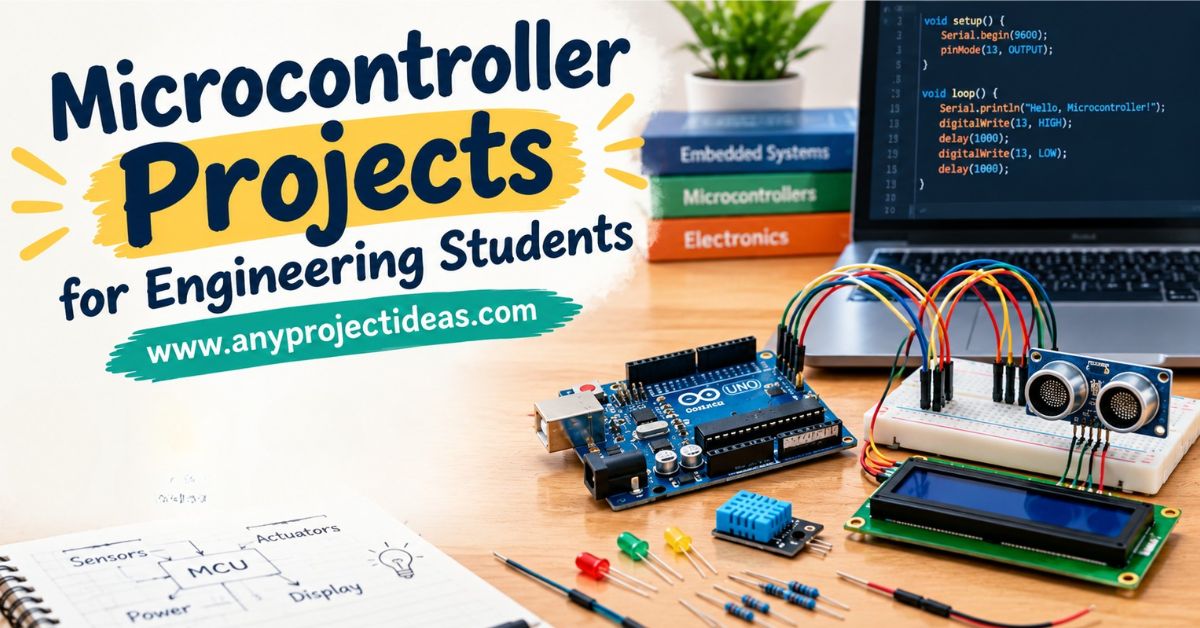
Microcontrollers are at the heart of many modern electronic systems, from smart home devices and wearable gadgets to industrial automation and robotics. For engineering students, building a practical microcontroller project is an excellent way to turn classroom concepts into working technology.
If you are searching for microcontroller projects for engineering students, there are hundreds of possibilities. You can build a simple temperature monitor, an automatic lighting system, a smart security device, a robotic vehicle, or a complete IoT-based system. The right project depends on your engineering branch, programming experience, available components, and project requirements.
Microcontroller projects also help students understand programming, sensors, communication protocols, embedded systems, circuit design, and real-time control. Instead of only reading about these concepts, students can see how hardware and software work together in an actual system.
This blog provides 110+ project ideas across beginner, intermediate, and advanced levels. Each idea can be modified according to your skills and academic requirements.
What Is a Microcontroller Project?
A microcontroller project is an electronic system built around a programmable microcontroller that receives information from sensors or other inputs, processes that information, and controls an output.
For example, a temperature-monitoring project may use a temperature sensor to collect data. The microcontroller processes the sensor reading and displays the temperature on an LCD or sends it to a mobile application.
Popular microcontroller platforms include Arduino-compatible boards, ESP32, ESP8266, STM32 boards, PIC microcontrollers, and other embedded development platforms. Students can choose a platform based on the complexity and communication requirements of their project.
You May Also Like: Leaf Craft Ideas for School Project
110+ Microcontroller Projects for Engineering Students
Beginner Microcontroller Project Ideas
These projects are suitable for students who are learning microcontroller programming and basic electronics.
- Automatic LED Light Controller
- Digital Temperature Monitor
- Electronic Doorbell
- Digital Stopwatch
- Digital Dice
- Automatic Night Lamp
- LED Pattern Generator
- Digital Counter
- Traffic Light Controller
- Electronic Voting Machine
- Automatic Fan Controller
- Digital Thermometer
- Light Intensity Meter
- Simple Digital Clock
- Water Level Indicator
- Motion Detection Alarm
- Touch-Activated Light
- Electronic Quiz Buzzer
- Battery Voltage Monitor
- LED Music Visualizer
These projects introduce students to GPIO pins, basic sensors, switches, LEDs, displays, timers, and simple programming logic. They are especially useful for understanding how a microcontroller communicates with electronic components.
Sensor-Based Microcontroller Projects
Sensors allow microcontrollers to interact with the physical environment. These projects are useful for engineering students who want to explore automation and measurement systems.
- Soil Moisture Monitoring System
- Smart Temperature Monitoring System
- Humidity Monitoring Device
- Gas Leakage Detector
- Air Quality Monitoring System
- Rain Detection System
- Flame Detection Alarm
- Ultrasonic Distance Meter
- Automatic Water Tank Controller
- Light-Based Object Detector
- Sound Level Monitoring System
- Vibration Detection System
- Pressure Monitoring System
- Infrared Object Counter
- Proximity Detection System
- Digital Weight Measurement System
- Smart Parking Sensor
- Automatic Hand Sanitizer
- Touchless Water Dispenser
- Smart Dustbin Using Ultrasonic Sensor
Sensor-based projects are valuable because they demonstrate a complete input-processing-output cycle. For example, a smart dustbin can detect when someone approaches and automatically open its lid using a motor.
IoT Microcontroller Project Ideas
IoT projects combine microcontrollers with internet connectivity. They are a good choice for students interested in connected devices and smart systems.
- IoT Home Automation System
- Internet-Based Temperature Monitor
- Smart Energy Monitoring System
- IoT Weather Station
- Remote Appliance Controller
- Cloud-Based Soil Monitoring System
- IoT Water Level Monitor
- Smart Street Light System
- Remote Health Monitoring Device
- IoT Air Quality Monitor
- Smart Agriculture Monitoring System
- Connected Security Alarm
- IoT Smart Parking System
- Remote Motor Control System
- Internet-Based Gas Detection System
- Smart Electricity Meter
- IoT Fire Detection System
- Smart Classroom Monitoring System
- Connected Plant Watering System
- IoT-Based Waste Monitoring System
ESP32 and similar Wi-Fi-enabled microcontrollers can be particularly useful for these projects because they allow sensor data to be transmitted to web dashboards or mobile applications.
Robotics Microcontroller Projects
Robotics is one of the most popular areas for engineering projects because it combines programming, electronics, mechanical design, and control systems.
- Line-Following Robot
- Obstacle-Avoiding Robot
- Bluetooth-Controlled Robot
- Wi-Fi-Controlled Robot
- Gesture-Controlled Robot
- Voice-Controlled Robot
- Automatic Garbage Collection Robot
- Fire-Fighting Robot
- Robotic Arm
- Pick-and-Place Robot
- Maze-Solving Robot
- Object-Tracking Robot
- Remote-Controlled Car
- Smart Delivery Robot
- Autonomous Surveillance Robot
- Wall-Following Robot
- Mini Humanoid Robot
- Color-Sorting Robot
- Self-Balancing Robot
- Smart Warehouse Robot
A robotics project becomes more impressive when students clearly explain the control logic. For instance, an obstacle-avoiding robot can use ultrasonic sensors to measure distance and change the motor direction when an obstacle is detected.
Automation Project Ideas
Microcontrollers are widely used in automation because they can monitor conditions and perform actions automatically.
- Automatic Room Lighting System
- Smart Curtain Controller
- Automatic Irrigation System
- Automatic Fan Speed Controller
- Smart Classroom Lighting
- Automatic Gate Controller
- Automatic Street Light
- Smart Elevator Prototype
- Automatic Plant Watering System
- Automatic Pet Feeder
- Smart Parking Gate
- Automatic Conveyor Belt
- Industrial Temperature Controller
- Automatic Bottle Filling System
- Smart Home Appliance Controller
Automation projects are useful for demonstrating how repetitive tasks can be performed using sensors, programmed decisions, and actuators.
Security-Based Microcontroller Projects
Security systems are another practical application of embedded technology. These projects can combine sensors, alarms, displays, cameras, and communication modules.
- Digital Door Lock
- RFID-Based Door Access System
- Password-Protected Security System
- Motion Detection Security Alarm
- Smart Intruder Alarm
- RFID Attendance System
- Fingerprint-Based Access System
- Electronic Locker Security System
- Smart Bicycle Security Alarm
- GPS-Based Vehicle Tracking System
- Gas Leakage Security Alarm
- Fire and Smoke Detection System
- Smart Home Security System
- RFID-Based Vehicle Access System
- Emergency Alert System
- Multi-Sensor Security System
These projects can help students understand authentication, sensor integration, wireless communication, and alarm systems.
Microcontroller Projects for Electrical Engineering Students
Electrical engineering students can focus on projects involving power monitoring, motor control, energy management, and automation.
Some useful ideas include:
- Smart energy meter
- Digital power factor monitor
- Automatic power-saving system
- DC motor speed controller
- Battery monitoring system
- Solar panel tracking system
- Solar charge controller
- Transformer temperature monitor
- Overvoltage protection system
- Overcurrent monitoring system
- Automatic load controller
- Power consumption analyzer
- Smart street lighting
- Battery charging monitor
- Motor protection system
These projects can demonstrate how embedded controllers interact with electrical equipment while allowing students to study measurement and control principles.
Microcontroller Projects for Electronics Engineering Students
Electronics students can explore communication, displays, sensors, signal processing, and digital control.
Possible projects include:
- Digital frequency meter
- Digital signal monitor
- LCD information system
- Wireless sensor node
- Infrared communication system
- Bluetooth-controlled device
- RFID reader system
- Digital code lock
- Electronic voting system
- Wireless data logger
- Sensor calibration system
- Digital alarm clock
- Audio level indicator
- Serial communication analyzer
- Multi-channel temperature monitor
These projects can be expanded by adding displays, communication modules, data logging, or mobile connectivity.
Microcontroller Projects for Computer Engineering Students
Computer engineering students can combine embedded hardware with programming and networking.
Recommended ideas include:
- Smart attendance system
- IoT classroom system
- Web-controlled appliances
- Smart inventory monitor
- Embedded weather station
- IoT security system
- Smart parking application
- RFID library management system
- Remote device monitoring
- IoT-based home dashboard
- Smart energy dashboard
- Embedded access control system
- Wireless sensor network
- Connected environmental monitor
- Smart notification system
These projects provide opportunities to develop both hardware and software skills. Students can create dashboards, mobile interfaces, databases, or web applications to interact with their microcontroller system.
How to Choose the Right Microcontroller Project?
Choosing a project should not be based only on how impressive the final demonstration looks. A good engineering project should also be realistic to build, test, explain, and document.
Consider these factors before making your decision:
1. Match the project to your skill level
If you are new to embedded programming, start with LEDs, sensors, displays, and simple motors. More advanced projects can involve wireless communication, robotics, computer vision, or multiple sensors.
2. Check component availability
Before selecting a project, make a list of required components. Make sure the sensors, motors, communication modules, power supplies, and microcontroller board are available and affordable.
3. Think about your project objective
Your project should solve a specific problem or demonstrate a useful concept. For example, instead of simply building an automatic fan, you could create a temperature-based smart fan controller that adjusts speed according to room temperature.
4. Consider the presentation
A project that works reliably is easier to demonstrate than an unnecessarily complicated system. Make sure you can explain the circuit, programming logic, components, limitations, and results.
5. Leave time for testing
Hardware projects often require troubleshooting. Sensors may give unexpected readings, wires may become loose, and software may contain bugs. Keep enough time for testing and improvements.
How to Make a Microcontroller Project More Impressive?
A basic project can become much more valuable when students add meaningful features rather than unnecessary complexity.
For example, a simple temperature monitor could be upgraded with:
- LCD or OLED display
- Data logging
- Wi-Fi connectivity
- Mobile notifications
- Graphs and historical readings
- Automatic fan control
- Temperature alerts
This approach demonstrates that the student understands both the basic concept and how the system can be improved for practical use.
Common Components Used in Microcontroller Projects
Most engineering projects use a combination of electronic components. Some commonly used parts include:
- Microcontroller development board
- LEDs
- Resistors
- Capacitors
- Push buttons
- LCD or OLED displays
- Ultrasonic sensors
- Temperature sensors
- Humidity sensors
- IR sensors
- Servo motors
- DC motors
- Motor driver modules
- Relay modules
- RFID modules
- Bluetooth modules
- Wi-Fi modules
- Buzzer
- Breadboard
- Jumper wires
- Battery or power supply
The exact components depend on the project. Students should always check the voltage and current requirements of each component before connecting hardware.
Tips for Successfully Completing Your Project
Start by creating a simple block diagram showing the input, microcontroller, processing stage, and output. Then build the circuit gradually instead of connecting every component at once.
Test individual components before combining them. For example, test the temperature sensor separately before connecting it to the display and fan controller.
Keep your code organized and add comments explaining important sections. During your final presentation, be prepared to explain why you selected the microcontroller, what each sensor does, how the program makes decisions, and what limitations your prototype has.
Most importantly, document your testing results. A strong project report should explain the problem, objectives, methodology, components, circuit design, programming, testing, results, limitations, and possible future improvements.
Don’t Skip: What Risk Is Posed By Internet Of Things Devices?
Final Thoughts
Microcontroller projects give engineering students a practical way to connect programming, electronics, sensors, communication, and control systems. The best project is not necessarily the most complicated one. A well-designed project that solves a clear problem and works reliably can provide valuable hands-on experience.
Whether you are interested in robotics, IoT, automation, electrical systems, electronics, or computer engineering, these 110+ microcontroller projects for engineering students provide plenty of directions to explore. Choose an idea that matches your skills and available resources, then improve it with useful features and thorough testing.
A successful project should demonstrate more than a working circuit. It should show that you understand the problem, can design a solution, can troubleshoot challenges, and can clearly explain how your system works.
Frequently Asked Questions (FAQ)
What are good microcontroller projects for engineering students?
Good projects include IoT systems, robots, smart agriculture, home automation, security systems, energy monitors, sensor networks, and motor-control applications.
Which microcontroller is best for student projects?
The best choice depends on project requirements. Arduino is beginner-friendly, while ESP32 suits connected projects and STM32 supports more advanced embedded applications.
Are microcontroller projects difficult for beginners?
Many beginner projects are simple when divided into smaller steps. Start with LEDs, buttons, sensors, and displays before attempting complex robotic or IoT systems.
How can I make a microcontroller project unique?
Add a useful feature, improve automation, collect data, create a dashboard, solve a specific problem, or combine multiple sensors instead of copying a basic design.
What should a microcontroller project report include?
A project report should normally include objectives, methodology, components, circuit design, software, testing, results, limitations, conclusion, and possible future improvements.