
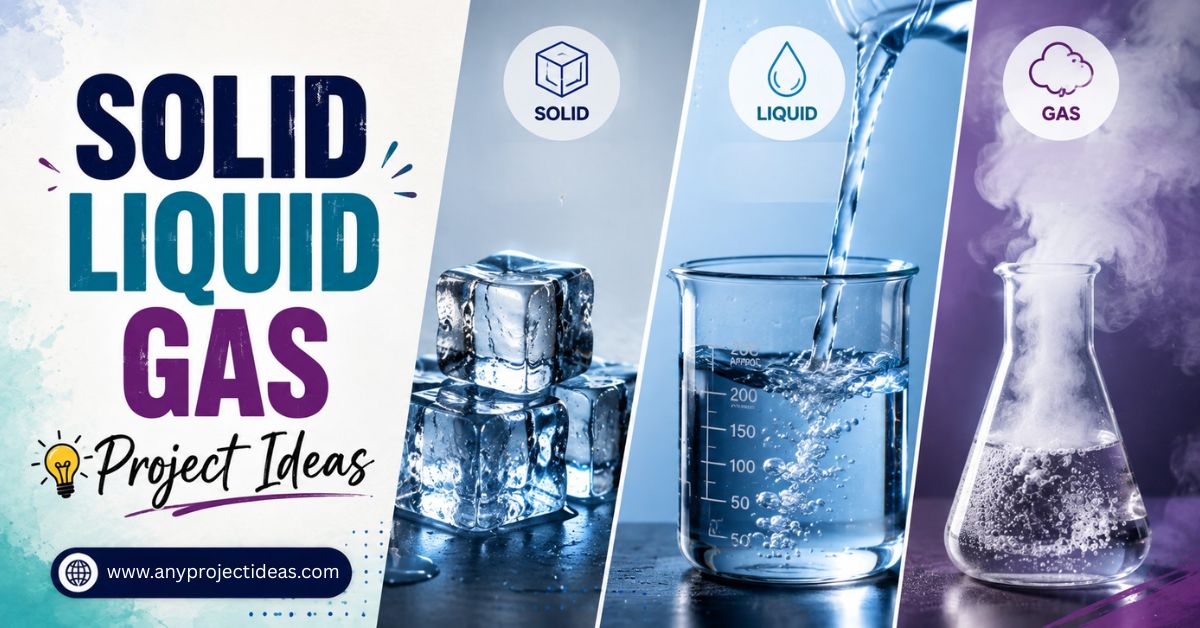
Finding interesting solid liquid gas project ideas can make a science assignment much more exciting. The three states of matter are among the first major science concepts students learn, but that does not mean projects about them have to be boring. With the right idea, students can explore how particles behave, how matter changes state, and how temperature affects solids, liquids, and gases.
A good project does more than show that ice is a solid, water is a liquid, and steam is a gas. It encourages students to observe, compare, predict, test, and explain. For example, students can investigate which solid melts fastest, how evaporation changes with temperature, or how gases expand when heated.
The best part is that many solid, liquid, and gas activities can use simple materials found at home or in the classroom. However, students should always follow teacher instructions and use proper safety precautions, especially when working with heat, glass, or chemicals.
This guide includes 105 solid liquid gas project ideas, along with practical tips for choosing, planning, and presenting a successful science project.
Understanding Solids, Liquids, and Gases
Before choosing a project, it helps to understand the basic differences between the three common states of matter.
Solids
Solids have a definite shape and a definite volume. Their particles are packed closely together and mainly vibrate in fixed positions.
Examples include:
- Ice
- Wood
- Rocks
- Metal
- Plastic
- Salt
A solid generally keeps its shape unless an outside force changes it.
Liquids
Liquids have a definite volume but do not have a fixed shape. They flow and take the shape of their container because their particles can move around one another.
Examples include:
- Water
- Milk
- Juice
- Cooking oil
Gases
Gases have no fixed shape or volume. Their particles move freely and spread out to fill the available space.
Examples include:
- Air
- Oxygen
- Carbon dioxide
- Water vapor
Understanding these differences will help you create a project that explains not only what happens, but also why it happens.
Why Are Solid Liquid Gas Projects Important?
Projects about states of matter help students connect scientific concepts with everyday experiences. Matter changes state constantly around us. Ice melts in a drink, water evaporates from clothes, and water vapor condenses on a cold surface.
These projects can help students develop important skills such as:
- Observation
- Prediction
- Measurement
- Data collection
- Scientific reasoning
- Problem-solving
- Presentation skills
A simple experiment can also introduce larger scientific ideas. For example, comparing melting rates can lead to discussions about heat transfer, while studying evaporation can help students understand the water cycle.
You May Also Like: Breaking Social Norms Ideas Sociology
How to Choose the Best Solid Liquid Gas Project?
Not every project needs expensive materials or complicated equipment. In fact, a simple experiment with a clear question often produces better results than a complicated project with confusing data.
When choosing from different solid liquid gas project ideas, look for one that has a clear scientific question.
For example:
Weak question: What happens to ice?
Better question: Does the surface material underneath an ice cube affect how quickly it melts?
The second question allows you to make a prediction, control variables, collect data, and draw a conclusion.
Choose a Project That Allows Testing
A strong science project usually includes:
- A clear question
- A prediction or hypothesis
- Materials
- A procedure
- Observations or measurements
- Results
- A conclusion
Try to change only one major variable at a time. This makes your results easier to understand.
105+ Solid Liquid Gas Project Ideas
Solid Project Ideas
Solids provide many opportunities to explore properties such as hardness, melting, density, magnetism, and conductivity.
- Compare how quickly ice cubes melt on different surfaces.
- Test which material keeps an ice cube frozen the longest.
- Investigate whether the size of an ice cube affects melting time.
- Compare the melting rate of crushed ice and large ice cubes.
- Test how salt affects the melting of ice.
- Investigate whether sugar affects ice melting.
- Compare how different colors affect the melting rate of colored ice.
- Test whether ice melts faster in sunlight or shade.
- Investigate which type of container slows ice melting.
- Compare the hardness of different classroom materials.
- Test which solid materials float in water.
- Compare the density of different solid objects.
- Investigate which materials are attracted to magnets.
- Compare the strength of different types of paper.
- Test how folding paper changes its strength.
- Investigate whether the thickness of cardboard affects how much weight it can hold.
- Compare the flexibility of different solid materials.
- Test which building material makes the strongest small bridge.
- Compare the insulation properties of different solid materials.
- Investigate which material keeps an object warm the longest.
- Test how temperature affects the hardness of certain safe materials.
- Compare the absorption of water by different solid materials.
- Investigate which type of sponge absorbs the most water.
- Test how the size of a solid affects its surface area.
- Compare the dissolving rates of salt crystals of different sizes.
- Investigate which solid dissolves fastest in water.
- Compare how stirring affects the dissolving of a solid.
- Test how water temperature affects the dissolving rate of sugar.
- Investigate whether crushed solids dissolve faster than larger pieces.
- Compare the conductivity of different safe materials.
- Test which materials make the best sound barriers.
- Investigate how different solids affect sound vibrations.
- Compare the weight of equal-sized pieces of different materials.
- Test which solid materials are waterproof.
- Investigate whether freezing changes the appearance of certain safe materials.
Liquid Project Ideas
Liquid projects can focus on flow, viscosity, density, evaporation, surface tension, and temperature.
- Compare how quickly different liquids flow.
- Test which liquid has the highest viscosity.
- Compare the evaporation rates of different liquids.
- Investigate how temperature affects water evaporation.
- Test whether wind increases evaporation.
- Compare evaporation in sunlight and shade.
- Investigate whether a larger surface area increases evaporation.
- Test whether water evaporates faster from a shallow or deep container.
- Compare the evaporation of saltwater and fresh water.
- Investigate how food coloring spreads through water.
- Compare how food coloring moves through hot and cold water.
- Test how stirring affects the mixing of liquids.
- Investigate which liquids mix completely with water.
- Compare the density of oil, water, and syrup.
- Create a layered liquid density experiment.
- Test which liquid allows an object to float most easily.
- Compare the surface tension of plain water and soapy water.
- Investigate how soap changes water’s surface behavior.
- Test how many drops of water can fit on a coin.
- Compare how many drops of different liquids fit on the same surface.
- Investigate how liquid temperature affects surface tension.
- Test which liquid spreads fastest across a smooth surface.
- Compare how quickly different liquids are absorbed by paper towels.
- Investigate capillary action using colored water and paper towels.
- Compare capillary action in different paper materials.
- Test whether warmer water travels through a paper towel faster.
- Investigate how liquid density affects floating objects.
- Compare the freezing points of plain water and saltwater.
- Test how sugar affects the freezing process of water.
- Compare how quickly different amounts of water freeze.
- Investigate whether container shape affects freezing time.
- Compare the cooling rates of different liquids.
- Test which container keeps water cold the longest.
- Investigate how adding ice changes liquid temperature.
- Compare the flow of liquids at different temperatures.
Gas Project Ideas
Gas projects can demonstrate air pressure, expansion, compression, movement, and the fact that gases occupy space.
- Test whether air takes up space using a simple container experiment.
- Investigate how warm air affects a balloon.
- Compare balloon size in warm and cool environments.
- Test how cooling affects the volume of air in a balloon.
- Investigate whether gases can be compressed.
- Demonstrate air pressure using safe household materials.
- Compare how different balloon sizes affect travel distance in a balloon-powered model.
- Test whether the amount of air affects a balloon’s movement.
- Investigate how balloon shape affects movement.
- Compare the flight distance of paper rockets powered by air.
- Test how air resistance affects falling objects.
- Compare different parachute designs.
- Investigate how parachute size affects falling speed.
- Test which material makes the best parachute.
- Compare how different paper airplane designs interact with air.
- Investigate how wing size affects paper airplane distance.
- Test how air movement affects evaporation.
- Compare drying times in still and moving air.
- Investigate whether air pressure can support a lightweight object.
- Test how changing temperature affects gas expansion.
- Compare how quickly balloons deflate in different environments.
- Investigate whether a balloon loses air faster in warm or cool conditions.
- Test how air affects the movement of lightweight objects.
- Compare the effect of different fan speeds on paper objects.
- Investigate how air moves through different materials.
- Test which fabric allows the most air to pass through.
- Compare air resistance using different shapes.
- Investigate how the size of an opening affects airflow.
- Test how a change in air pressure can affect a flexible container.
- Compare how different objects move when exposed to moving air.
Solid, Liquid, and Gas Change-of-State Projects
Some of the most interesting projects explore what happens when matter changes from one state to another.
- Compare how quickly ice melts at different temperatures.
- Investigate how salt changes the melting process of ice.
- Compare the melting rates of ice cubes with different shapes.
- Test whether colored ice melts differently from clear ice.
- Investigate how container material affects melting.
- Compare evaporation rates at different temperatures.
- Test how surface area affects evaporation.
- Investigate condensation on containers with different temperatures.
- Compare how quickly water vapor condenses on different surfaces.
- Create a simple model showing evaporation and condensation.
- Investigate how humidity affects evaporation.
- Compare the freezing times of liquids with different dissolved substances.
- Test how insulation affects melting and freezing.
- Investigate which conditions produce the most visible condensation.
- Compare solid-to-liquid changes using different safe substances with teacher approval.
Easy Solid Liquid Gas Project Ideas for Younger Students
Younger students often benefit from projects that use simple materials and clear observations.
Ice Melting Race
Place equal-sized ice cubes in different locations, such as sunlight, shade, or on different surfaces. Measure how long each cube takes to melt.
This project introduces the effect of temperature and heat transfer.
Sink or Float Investigation
Collect safe objects made from different materials and predict whether they will sink or float. Record the results and compare the materials.
This activity can lead to a discussion about density.
Water Evaporation Test
Place equal amounts of water in different containers. Keep the conditions as similar as possible except for one variable, such as surface area.
Measure the water level over time.
Balloon Temperature Experiment
Place balloons in different temperature environments under safe, teacher-approved conditions. Observe how temperature can affect the volume of the gas inside.
Layered Liquid Density Jar
Carefully layer compatible liquids with different densities, such as syrup, water, and oil. Add small objects to observe where they settle.
Advanced Project Ideas for Middle and High School Students
Older students can create more detailed investigations by collecting numerical data and controlling variables carefully.
Compare Evaporation Rates
Measure the amount of water lost from identical containers under different conditions. You could test:
- Temperature
- Air movement
- Surface area
- Light exposure
Record measurements at regular intervals and create a graph.
Investigate Insulation
Test several materials to determine which one slows the melting of ice most effectively. Use equal-sized ice cubes and identical containers.
A strong project could calculate the percentage of ice remaining after a set period.
Study Air Resistance
Build several parachutes that differ in size or shape. Drop them from the same safe height and measure the time required to reach the ground.
Repeat each test several times to improve reliability.
Explore Dissolving and Temperature
Test how quickly a solid, such as sugar or salt, dissolves in equal amounts of water at different temperatures.
Keep the amount of solid and the stirring method consistent.
How to Make Your Project More Scientific?
A visually attractive project is helpful, but good science depends on a clear method.
Create a Testable Hypothesis
A hypothesis should predict what you think will happen.
For example:
If water temperature increases, then sugar will dissolve faster because the particles have more energy and move more quickly.
A good hypothesis connects the prediction with a scientific reason.
Identify Your Variables
The independent variable is what you intentionally change.
The dependent variable is what you measure.
The controlled variables are the conditions you keep the same.
For an ice-melting experiment:
- Independent variable: Surface type
- Dependent variable: Time required for the ice to melt
- Controlled variables: Ice cube size, room conditions, and measurement method
Repeat Your Experiment
One trial may produce an unusual result. Repeating the experiment helps make your findings more reliable.
Three or more trials can provide a stronger basis for comparison in many school projects, depending on the assignment requirements.
How to Present Your Solid Liquid Gas Project?
A well-organized display makes your work easier to understand.
Your project board can include:
Title
Choose a clear and interesting title.
Example: Does Surface Area Affect How Fast Water Evaporates?
Question
State exactly what you wanted to investigate.
Hypothesis
Explain what you predicted and why.
Materials
List all equipment and materials used.
Procedure
Describe the steps clearly enough for another student to understand and repeat the experiment.
Results
Use:
- Tables
- Graphs
- Photographs
- Measurements
- Observation notes
Conclusion
Explain whether your results supported your hypothesis. Also discuss anything unexpected that happened.
Common Mistakes to Avoid
Many projects become weaker because students change too many things at once.
For example, if you test ice cubes in different locations while also using different-sized cubes, you will not know which factor caused the difference.
Avoid these common mistakes:
- Changing multiple variables at the same time
- Using unequal amounts of materials
- Forgetting to record measurements
- Performing only one trial
- Writing a conclusion that does not match the data
- Ignoring unexpected results
- Choosing a project that is too complicated to complete accurately
Simple experiments with careful measurements can produce excellent science projects.
Don’t Skip: What Type of AI Is Designed to Perform a Specific Task Without General Understanding?
Conclusion
The three states of matter may seem like a basic science topic, but they offer countless opportunities for creative investigation. From testing how quickly ice melts to studying evaporation, density, air pressure, and gas expansion, students can explore important scientific principles using simple and practical experiments.
The 105+ solid liquid gas project ideas in this guide offer options for different ages, skill levels, and classroom requirements. The most important step is choosing an idea that interests you and allows you to ask a clear scientific question.
Remember that a successful project is not necessarily the most complicated one. A simple experiment with a fair test, accurate observations, repeated trials, and a thoughtful conclusion can be far more impressive. Choose your idea, make a prediction, collect your data, and let the science tell the story.
Frequently Asked Questions (FAQ)
1. What is a good solid liquid gas project?
A good project tests one clear question about matter, such as melting, evaporation, density, gas expansion, or how temperature changes a substance.
2. What are easy states of matter experiments?
Easy experiments include melting ice, testing evaporation, making liquid density layers, comparing sink or float results, and exploring air in balloons.
3. How can I explain solids, liquids, and gases?
Explain that solids keep their shape, liquids flow and take container shapes, while gases spread out and fill the available space around them.
4. What is the best experiment for changing states of matter?
Testing how temperature, salt, insulation, or surface type affects ice melting is a simple experiment that clearly demonstrates a change of state.
5. How do I make a states of matter project better?
Use a clear question, test one variable, repeat trials, record accurate data, add graphs, and explain results using scientific concepts.