
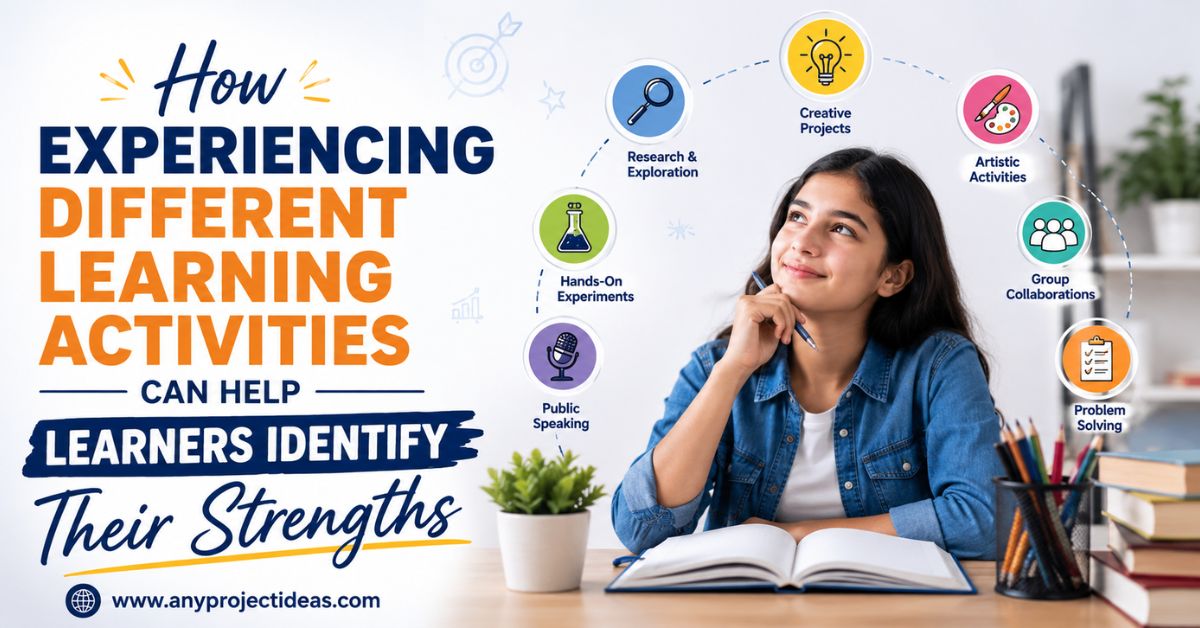
Not every learner discovers their strengths by sitting quietly in a classroom and getting good grades on traditional tests. Some students understand their abilities when they build something, others discover them through group discussions, experiments, creative projects, sports, presentations, or practical problem-solving. This is why experiencing different learning activities can play an important role in helping learners understand what they are naturally good at and which skills they can develop further.
A learner may believe they are “not good at school” simply because one particular learning method does not suit them. Give that same student a chance to design a project, explain an idea to classmates, solve a real-world problem, or create something with their hands, and a completely different ability may appear. Different activities provide different opportunities to demonstrate knowledge, creativity, communication, organization, leadership, and critical thinking.
Experiencing different learning activities can therefore help learners identify their strengths by giving them opportunities to compare their performance, interests, confidence, and progress across different situations. Instead of guessing what they are good at, learners can gather evidence from their own experiences. This self-awareness can guide subject choices, career planning, personal development, and future learning.
What Are Learning Activities?
Learning activities are tasks or experiences that help students gain knowledge, practice skills, solve problems, or understand ideas. They can take place inside or outside the classroom and may involve individual work, teamwork, technology, creativity, physical activity, or real-world experiences.
Examples include:
- Research projects
- Laboratory experiments
- Group discussions
- Presentations
- Debates
- Art and design activities
- Problem-solving exercises
- Field trips
- Educational games
- Writing assignments
- Coding projects
- Community service
- Practical demonstrations
- Peer teaching
Each activity can reveal different abilities. A written assignment may show strong writing and research skills, while a group project might reveal leadership or communication abilities.
You May Also Like: 10 Reasons Why Female Education Is Better Than Male Education for Society
Why Different Learning Experiences Matter?
If learners repeatedly use only one method of learning, they may get a limited picture of what they can do. For example, a student who struggles with written examinations may still have excellent practical reasoning, leadership, creativity, or verbal communication skills.
Different activities create different conditions for success. This gives learners more opportunities to discover abilities that traditional academic tasks may not reveal.
Learning Experiences Provide Opportunities to Explore
Think of learning activities as small experiments. A student tries something unfamiliar, observes how it feels, sees what challenges arise, and evaluates the result.
For example, a student might try:
- A science experiment
- A public speaking activity
- A creative writing assignment
- A group leadership task
- A technology project
After completing these activities, the student can compare which tasks felt engaging, which produced strong results, and which skills improved with practice.
This process can reveal patterns that are difficult to notice when learning follows the same routine every day.
How Experiencing Different Learning Activities Can Help Learners Identify Their Strengths?
1. It Helps Learners Discover What They Enjoy
Interest is an important clue when identifying strengths. A learner may naturally spend more time on activities that capture their attention.
For example, a student who becomes deeply interested in designing a small robot may discover a strong interest in engineering. Another student who enjoys organizing a class presentation may discover an interest in communication or leadership.
Enjoyment does not automatically mean someone is talented at an activity, but it can provide motivation to practice and improve.
2. It Reveals Different Types of Skills
Not every strength appears in the same way. Different activities allow different skills to become visible.
A group project may reveal:
- Leadership
- Cooperation
- Communication
- Organization
A science experiment may reveal:
- Observation
- Logical thinking
- Data analysis
- Problem-solving
An art project may reveal:
- Creativity
- Visual thinking
- Attention to detail
- Originality
By experiencing all three, learners develop a broader understanding of their abilities.
3. It Builds Self-Awareness
Self-awareness means understanding your own abilities, interests, habits, and areas for improvement. It develops gradually through experience and reflection.
A learner might initially think, “I’m bad at presentations.” After participating in several short presentations, they may realize that the problem was not speaking itself but lack of preparation. With practice, their confidence may improve.
Reflection helps learners distinguish between a genuine weakness and a skill they simply have not practiced enough.
4. It Allows Learners to Compare Their Performance
Trying different activities gives students useful comparison points.
Imagine a student who performs average on written tests but consistently performs well in debates and group presentations. That pattern may suggest strong verbal communication and reasoning skills.
The learner should not immediately label themselves based on one result. Instead, repeated experiences can provide more reliable evidence.
Look for Patterns
Ask questions such as:
- Which activities do I perform well in repeatedly?
- Which tasks do I enjoy practicing?
- What do classmates or teachers compliment me on?
- Which challenges do I solve more easily than others?
- Which skills improve quickly when I practice them?
Patterns are often more informative than a single successful or unsuccessful experience.
5. It Builds Confidence Through Success
Successfully completing unfamiliar activities can change how learners view themselves.
A student who has always struggled with mathematics might discover that they are excellent at explaining mathematical concepts to younger students. That experience can create confidence and encourage them to explore related areas.
Small successes matter because they provide evidence that ability is not limited to one subject or one type of task.
6. It Encourages Learners to Leave Their Comfort Zones
People often stick to activities they already know. While comfort can be useful, it can also prevent discovery.
Trying something new may initially feel uncomfortable. A student who has never spoken publicly may feel nervous during a presentation. Someone who has never used coding software may feel confused during their first programming project.
The important part is what happens afterward. Learners may discover abilities they never knew they had.
7. It Helps Identify Preferred Ways of Working
Different activities also show learners what type of environment suits them.
One student may perform best independently, while another becomes more productive when collaborating with others. Someone may enjoy structured tasks, while another thrives when given freedom to create.
This information can become useful later when choosing courses, internships, careers, or work environments.
Examples of Learning Activities That Can Reveal Strengths
Project-Based Learning
Projects allow students to research, plan, create, and present something. Because they involve several stages, they can reveal multiple strengths.
A student working on an environmental project might discover that they enjoy collecting data, while another may prefer designing the presentation.
Group Work
Group activities can reveal communication, leadership, negotiation, and teamwork skills.
For instance, a student who naturally organizes responsibilities and keeps the team focused may have strong leadership potential.
Debates and Discussions
Debates encourage students to research information, build arguments, listen carefully, and respond to opposing viewpoints. These activities can reveal strengths in communication, reasoning, and critical thinking.
Practical Experiments
Hands-on activities can reveal problem-solving, observation, technical, and analytical skills.
A student who struggles to remember scientific definitions may perform exceptionally well when conducting experiments and interpreting results.
Creative Activities
Writing, drawing, music, drama, photography, and design provide opportunities for creative expression. These activities may uncover strengths that traditional academic tasks do not show.
The Role of Reflection in Identifying Strengths
Simply participating in activities is not enough. Learners should also think about what each experience teaches them.
After completing an activity, spend a few minutes answering questions such as:
- What part of the activity did I enjoy most?
- What part did I find easiest?
- What was difficult?
- What did I learn about myself?
- What feedback did I receive?
- Would I like to try a similar activity again?
Keeping a simple learning journal can make these patterns easier to recognize.
Use Feedback From Others
Teachers, classmates, parents, coaches, and mentors may notice strengths that learners overlook.
For example, a student may think they are simply “helping” during group work, while their teacher notices that they consistently explain difficult concepts clearly to classmates.
Feedback becomes especially useful when it is specific. “You’re good at this” is less helpful than “You explain complicated ideas clearly and keep the group organized.”
How Schools Can Help Learners Discover Their Strengths?
Schools can support strength discovery by providing a wide range of learning experiences rather than relying only on lectures and written examinations.
Offer Variety
Students should have opportunities to participate in:
- Practical work
- Creative projects
- Team activities
- Independent research
- Presentations
- Technology-based tasks
- Community activities
Encourage Exploration
Learners should not feel that they must immediately choose one area and ignore everything else. Exploration is part of learning.
A student may try drama one semester, robotics the next, and community service later. Each experience can provide useful information about their interests and abilities.
Reward Progress, Not Just Perfect Results
A student does not need to be immediately excellent at an activity for it to reveal a potential strength. Improvement, persistence, curiosity, and willingness to learn are also valuable indicators.
How Learners Can Turn Strengths Into Future Goals?
Once learners identify recurring strengths, they can connect them to future opportunities.
For example:
Strong communication + interest in society = journalism, law, teaching, public relations, or public administration.
Strong problem-solving + interest in technology = engineering, computer science, data analysis, or software development.
Creativity + interest in visual work = graphic design, architecture, animation, photography, or digital media.
Leadership + organization = business, management, event planning, entrepreneurship, or community leadership.
These connections are not fixed career predictions. Interests and abilities can change over time. They simply provide useful directions for further exploration.
Common Mistakes Learners Should Avoid
Assuming One Grade Defines a Strength
A single test score does not measure every ability. Strengths can appear in many forms.
Comparing Yourself Constantly With Others
Someone else’s strength does not make your own ability less valuable. Focus on personal growth and recurring patterns in your performance.
Giving Up Too Quickly
A difficult first experience does not necessarily mean you lack ability. Some strengths emerge only after practice.
Choosing Activities Only Because They Look Impressive
An activity is more valuable when you genuinely participate and learn from it. Joining something only for appearances can make the experience less meaningful.
Don’t Skip: When Would You Increase The Pressure In Your Tyres So That It’s Above The Normal Value?
Conclusion
Experiencing different learning activities can help learners identify their strengths because it gives them opportunities to test different skills in different situations. A student may discover strong communication skills through debate, creativity through art, leadership through group projects, analytical ability through science experiments, or practical problem-solving through technology projects.
The most important part of this process is not being immediately successful at everything. It is paying attention to patterns. Notice what you enjoy, what you improve at, what others recognize, and which challenges motivate you to keep learning.
Learners are not limited to the abilities revealed by traditional exams. When schools provide varied experiences and students take time to reflect on them, learning becomes a powerful process of self-discovery. Those discoveries can influence subject choices, confidence, personal goals, and eventually career decisions.
Trying different activities is therefore not simply a way to make school more interesting. It is a practical way for learners to understand themselves better and discover strengths they may not have known they possessed.
Frequently Asked Questions (FAQ)
1. How do different learning activities help students discover strengths?
Different activities expose learners to varied tasks, allowing them to notice recurring skills, interests, feedback, and areas where they perform confidently.
2. Why is it important for learners to try different activities?
Trying varied activities helps students move beyond familiar routines and discover abilities in communication, creativity, leadership, problem-solving, and teamwork.
3. Can learning activities improve self-confidence?
Yes. Completing new tasks and seeing progress can help learners recognize their abilities, build confidence, and become more willing to tackle future challenges.
4. How can teachers help students identify their strengths?
Teachers can offer varied tasks, observe student performance, provide specific feedback, and encourage reflection instead of judging ability from one assessment.
5. How can students use their strengths for future careers?
Students can connect recurring strengths and interests with subjects, courses, volunteering, projects, and careers that require similar skills and abilities.